
Home / AEO and GEO / 8 Differences Between Chatbots and Search Engines in AEO GEO
Differences Between Chatbots and Search Engines in AEO GEO Key Takeaways
Understanding the Differences Between Chatbots and Search Engines in AEO GEO is essential for modern content strategists.
- Chatbots generate conversational responses from neural models, while search engines display ranked web links.
- User intent handling differs: chatbots clarify through dialogue; search engines match keywords and backlinks.
- SEO strategies must evolve to include conversational AI optimization alongside classic on-page and technical SEO.
Table of Contents
- Why Mastering These Differences Matters for Your SEO Strategy
- Difference 1: How They Interpret and Handle User Intent
- Difference 2: Result Delivery – Answers vs. Links
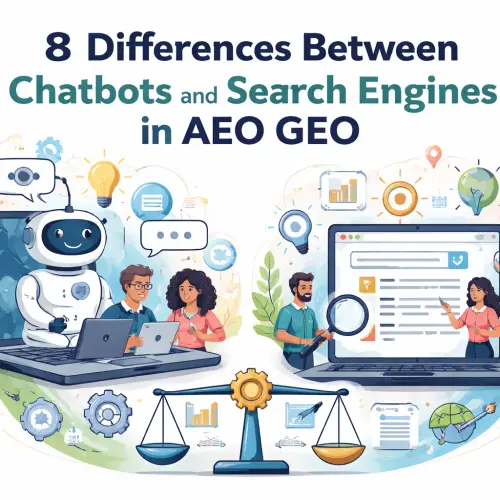
Why Mastering These Differences Matters for Your SEO Strategy
The rise of platforms like ChatGPT, Google Bard, Bing AI, and Perplexity has introduced a new paradigm in how users find information. Instead of scanning a search results page, users now receive direct, synthesized answers. This transition from traditional search results to answer engines requires a deep understanding of both the Differences Between Chatbots and Search Engines in AEO GEO and how to optimize content for each medium. Ignoring these differences can leave your content invisible to a growing segment of digital users. For a related guide, see 15 Differences Between Traditional SEO vs AEO GEO.
Difference 1: How They Interpret and Handle User Intent
The most fundamental difference lies in intent handling. A chatbot processes queries by analyzing conversational context across multiple turns. If you ask a follow-up question, the chatbot remembers the prior exchange. Search engines, in contrast, treat each query as a fresh signal, using keyword matching and semantic analysis to infer intent from a single entry.
This means chatbots handle user intent compared to search engines by maintaining a session history. For example, asking “What are its benefits?” after “Tell me about renewable energy” works naturally with a chatbot. On Google, you must rephrase the query explicitly. Understanding how the two systems manage this distinction is crucial when designing content for conversational AI vs search engines.
Difference 2: Result Delivery – Answers vs. Links
One core question marketers ask is: how do chatbots differ from search engines in delivering results? Chatbots provide a single, crafted answer—a paragraph or list—often without visible citations. Search engines show a ranked list of blue links, each with its own snippet, title, and URL. This shift from multiple options to one authoritative reply changes how users consume information.
In the context of AI search vs chatbot differences, this also impacts engagement. With search engines, users often click multiple results. With chatbots, users tend to accept the answer at face value, making authority and accuracy paramount. This is why zero click search vs chatbot answers is a growing topic—chatbots can satisfy queries without any click-through.
How Search Engines Present Results vs. Chatbots
Search engines rely on a ranked list with rich snippets, images, and knowledge panels. Chatbots present a single flowing response. For instance, a search for “best running shoes” returns dozens of review links. A chatbot generates a curated tiered recommendation list. This search engine ranking vs AI answers dynamic forces you to rethink how you structure information for maximum visibility in both channels.
Difference 3: Information Retrieval and Generation Mechanics
Another critical distinction is how do AI chatbots retrieve and generate answers vs. how do search engines index and rank content. Chatbots use large language models (LLMs) trained on vast corpora. They generate answers probabilistically, using the patterns they learned. Search engines, on the other hand, maintain a real-time index of web pages, ranking them based on algorithms like PageRank, relevance signals, and user behavior.
This means chatbots can produce answers that are fluent but not always factual, while search engines link directly to source material. For chatbot content optimization, you need to ensure your site’s information is structured in a way that LLMs can easily extract—using clear headers, concise definitions, and authoritative external citations. For AI chatbots SEO, this may also involve optimizing for featured snippets, since these often feed into chatbot training data.
Difference 4: Ranking Factors and Authority Signals
When comparing what are ranking factors in chatbots vs search engines, the differences are stark. Search engines weigh backlinks, domain authority, content freshness, page speed, and thousands of algorithmic signals. Chatbots do not have a traditional ranking system. Instead, they prioritize information based on frequency, recency, and the structure of training data.
For example, a chatbot might favor a Wikipedia page because it’s widely referenced, not because it has high domain authority. This changes the game for AEO GEO chatbot optimization. You must optimize for both systems: build backlinks and technical SEO for search engines, but also create authoritative, citation-ready content for chatbots. This dual-approach is essential for answer engines vs search engines optimization.
Difference 5: Content Optimization Strategies
How does content optimization differ for chatbots and search engines? For search engines, you optimize around keywords, meta tags, headings, and internal linking. For chatbots, you optimize for clarity, conciseness, and direct answers. Chatbots favor question-answer formats, bulleted lists, and definitions. This is where conversational AI vs search engines content diverges.
To succeed in chatbot content optimization, consider adding an FAQ section, writing in plain language, and structuring your main points as clear, isolated statements. This helps LLMs extract your content for generated answers. Meanwhile, traditional on-page SEO remains vital for keeping those pages visible in search engine results. Balancing both is now part of a mature SEO content strategy.
Difference 6: User Interaction and Feedback Loops
Another element of the Differences Between Chatbots and Search Engines in AEO GEO is the interaction model. A chatbot conversation is dynamic, allowing users to ask follow-ups, refine queries, and even provide feedback (thumbs up/down). Search engine interaction is static: you type, and you get a results page. There is no conversational thread.
This means how does user interaction differ between chatbots and search engines is not just about format but also about trust and engagement. Chatbots can build rapport and guide users through complex topics. Search engines remain a pull model—users find information themselves. For conversational search SEO, you may need to anticipate dialogue trees in your content, structuring information to answer likely follow-up questions.
Difference 7: Platforms and Ecosystem Coverage
When you ask what platforms are considered chatbots vs search engines, the list includes familiar names. Search engines: Google, Bing, Yahoo, DuckDuckGo. Chatbots: ChatGPT, Google Bard, Claude, Perplexity, and Bing AI (which combines both search and answer generation). The lines are blurring as these platforms converge, but the core mechanics remain different.
For ChatGPT vs Google Search specifically, ChatGPT provides synthesized answers based on a static training set (plus optional browsing), while Google search constantly crawls the live web. This distinction matters for timeliness. If your content covers breaking news, Google search is more likely to include it quickly. For evergreen, authoritative content, both mediums rely heavily on established sources. Understanding this helps you prioritize content creation efforts. For a related guide, see 12 Reasons AEO GEO Matters in the Age of AI Search.
Difference 8: Impact on SEO and Future Strategy
Finally, how do chatbots affect SEO strategies? Traditional SEO focused on ranking high on search engine results pages. AI chatbots SEO shifts the goalpost: you now need your content to be “picked up” by language models. This involves building topical authority, getting cited by high-authority sources, and structuring content in a machine-readable way.
The advantages of chatbots over search engines include higher engagement and faster answers. The limitations of chatbots vs search engines include lack of real-time updates and potential for inaccuracy. As the field of AEO GEO matures, a balanced strategy that speaks to both systems will outperform one that targets only one. The key is to understand the Differences Between Chatbots and Search Engines in AEO GEO and adapt your workflow accordingly.
Aspect Chatbots (e.g., ChatGPT) Search Engines (e.g., Google) Intent handling Conversational, multi-turn Single query, keyword-based Result format Single synthesized answer List of ranked links + snippets Information source Training data (LLM) Live web index Ranking factors Pattern frequency, authority of sources Backlinks, quality, freshness, signals Content optimization Concise Q and A, definitions Keywords, meta, structure User interaction Dialogue, follow-ups Static search page Timeliness Depends on training data recency Real-time crawl Best for Quick, conversational answers Comprehensive exploration Practical Takeaways for Content Strategists and SEO Specialists
Understanding the Differences Between Chatbots and Search Engines in AEO GEO leads to clear action items. First, create content that answers specific questions directly. Use chatbot content optimization techniques like FAQ pages, concise definitions, and bulleted lists. Second, maintain traditional SEO best practices for search engines: keyword research, backlink building, on-page optimization, and technical SEO. Third, monitor how your content appears in chatbot outputs (e.g., by testing with ChatGPT or Perplexity). Fourth, build topical authority by covering subjects comprehensively, because LLMs rely on frequently cited and authoritative sources. Finally, stay updated as the fields of generative AI search platforms and conversational search SEO evolve rapidly.
Useful Resources
Search Engine Land – The Difference Between AEO and SEO
This article explains how answer engine optimization contrasts with traditional SEO, giving you a foundational understanding of the shift toward conversational AI.
Read more about AEO vs SEO on Search Engine LandMoz – How to Optimize for Featured Snippets
Feature snippets often feed into chatbot training data, making snippet optimization a key tactic for AI chatbots SEO.
Learn about snippet optimization at MozFrequently Asked Questions About Differences Between Chatbots and Search Engines in AEO GEO
What is the difference between chatbots and search engines in AEO GEO?
Chatbots generate conversational answers using AI models, while search engines display ranked web links based on an index. In AEO GEO, chatbots prioritize direct, synthesized answers, whereas search engines rely on keyword matching and link authority.
How do chatbots differ from search engines in delivering results?
Chatbots provide a single, crafted response (often without links), while search engines present a list of links with snippets. This affects how users trust and engage with the information.
What makes chatbots different from traditional search engines?
Chatbots maintain conversation context across turns, generate unique answers, and rely on training data rather than a live index. Traditional search engines treat each query independently and crawl the web in real time.
How do AI chatbots retrieve and generate answers?
They use large language models trained on text corpora. The model predicts the most likely sequence of words to answer the query, based on patterns learned during training.
How do search engines index and rank content?
Search engines use crawlers to scan web pages, add them to an index, and rank them using algorithms that consider hundreds of signals like backlinks, keyword relevance, page speed, and user engagement.
What are the key differences between conversational AI and search engines?
Conversational AI (chatbots) allows back-and-forth dialogue, intent clarification, and personalized answers. Search engines are query-response systems that return a static results page without follow-up interaction.
How does ChatGPT differ from Google Search?
ChatGPT generates answers from its training data without live web access (unless browsing is enabled), while Google Search retrieves and ranks live web pages. ChatGPT offers conversational follow-ups; Google does not.
How do chatbots handle user intent compared to search engines?
Chatbots interpret intent across the conversation history, allowing them to answer ambiguous follow-ups. Search engines rely on the current query and may require additional refinement to narrow results.
What are the advantages of chatbots over search engines?
Chatbots provide faster, conversational answers, reduce the need to browse multiple sites, and can handle complex, multi-step questions seamlessly.
What are the limitations of chatbots vs search engines?
Chatbots can generate plausible but incorrect answers (hallucinations), lack real-time updates for breaking news, and offer less transparency about information sources compared to search engine result pages.
How does AEO GEO apply to chatbots vs search engines?
AEO (Answer Engine Optimization) and GEO (Generative Engine Optimization) focus on making content chatbot-friendly. This means structuring answers clearly so LLMs can extract them, while traditional SEO remains for search engine visibility.
How do chatbots affect SEO strategies?
They force SEOs to optimize for direct answers, featured snippets, and authoritative content that LLMs trust. A balanced strategy now includes both classic SEO and chatbot-focused content optimization.
How do search engines present results compared to chatbots?
Search engines display a visual list of links with titles, snippets, and images. Chatbots deliver a single text response, often in paragraph or bullet form, sometimes with small icons but rarely with multiple suggested links.
What is conversational search vs traditional search?
Conversational search involves a dialogue with a chatbot that remembers context, while traditional search is a one-off query to a search engine that returns a list of ranked pages.
How do chatbots use AI to generate answers?
They use transformer-based neural networks to predict the most relevant answer based on patterns learned from billions of text examples.
How do search engines use algorithms to rank pages?
Through complex algorithms like Google’s PageRank and BERT, which evaluate links, content relevance, user signals, and semantic understanding to order results.
What platforms are considered chatbots vs search engines?
Chatbots: ChatGPT, Google Bard, Claude, Perplexity, Bing AI (chat mode). Search engines: Google, Bing, Yahoo, DuckDuckGo. Some platforms like Bing AI combine both.
How does user interaction differ between chatbots and search engines?
Chatbots engage users in a dialogue with follow-ups and corrections. Search engines provide a static page that users must browse manually.
What are ranking factors in chatbots vs search engines?
Search engines use over 200 ranking factors including backlinks and page speed. Chatbots rank based on frequency and authority of sources in their training data, not a public ranking algorithm.
How does content optimization differ for chatbots and search engines?
For chatbots, optimize for clarity, direct answers, and structured Q and A. For search engines, focus on keywords, meta tags, backlinks, and technical SEO. Both require high-quality, authoritative information.

I am a dedicated writer and researcher behind BecomingSEO, focused on creating clear, practical, and results-driven content in the field of search engine optimization and digital growth. With a strong interest in how content, data, and strategy intersect, I aim to simplify complex SEO concepts into actionable insights that businesses and individuals can apply immediately.
Through BecomingSEO, I share knowledge on search visibility, content strategy, and emerging trends, helping readers build a stronger online presence in an ever-evolving digital landscape. My work is grounded in continuous learning, analytical thinking, and a commitment to delivering content that is both informative and impactful.