
Home / AEO and GEO / 15 Differences Between Traditional SEO vs AEO GEO
Differences Between Traditional SEO vs AEO GEO Key Takeaways
The shift from traditional search engine optimization (SEO) to answer engine optimization (AEO) and generative engine optimization (GEO) marks a fundamental change in how content gets discovered.
- Traditional SEO prioritizes backlinks and keywords for page rankings, while AEO/GEO focuses on structured data and conversational answers for AI models.
- Content length and format differ dramatically: Traditional SEO favors long-form articles, whereas AEO/GEO prefers concise, fact-dense answers that AI can extract.
- Success metrics have evolved from click-through rates and dwell time to answer rate and brand mention frequency within AI overviews.
Table of Contents
- What Readers Should Know About the Differences Between Traditional SEO vs AEO GEO
- 1. The Core Objective: Ranking vs. Answering
- 2. Keyword Research: Transactional vs. Conversational
- 3. Content Structure: Linear vs. Modular
- 4. Success Metrics: Traffic vs. Answer Rate
- 5. Technical Foundation: Sitemaps vs. Entity Markup
- 6. Linking Strategy: Authority vs. Source Verification
- 7. User Intent: Search vs. Answer
- 8. Content Length: Long-Form vs. Snippet-Friendly
- 9. Role of AI: Optimization Tool vs. Target Platform
- 10. Competition: Domains vs. Entities
- 11. Paid Media Integration: Ads vs. Sponsored Answers
- 12. Skillset Demand: Writing vs. Data Annotation
- 13. Content Distribution: Search Engines vs. AI Ecosystems
- 14. Update Frequency: Static vs. Continuous
- 15. Ethical Considerations: Optimization vs. Manipulation
- Useful Resources
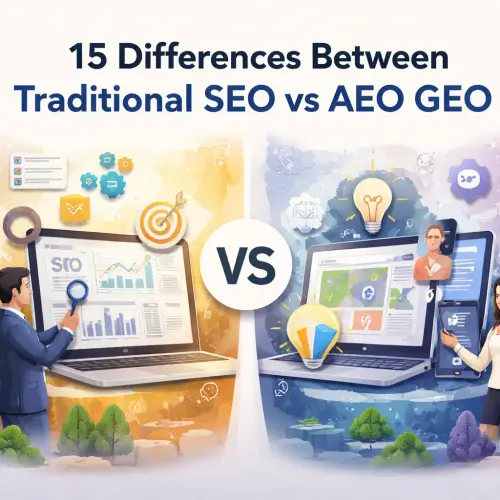
What Readers Should Know About the Differences Between Traditional SEO vs AEO GEO
For years, digital marketers built strategies around Google’s ten blue links. You optimized for keywords, built backlinks, and tracked rankings. But the search landscape has undergone a seismic shift. AI-powered features like Google’s AI Overviews, ChatGPT search, and Perplexity now generate direct answers without requiring users to click through to a website. This has given rise to two new disciplines: Answer Engine Optimization (AEO) and Generative Engine Optimization (GEO). Understanding the Differences Between Traditional SEO vs AEO GEO isn’t optional—it’s survival. Below, we break down 15 critical distinctions that every SEO specialist, content strategist, and growth marketer must know. You can also browse more posts in aeo-geo.
1. The Core Objective: Ranking vs. Answering
Traditional SEO aims to rank a webpage as high as possible in search engine results pages (SERPs). The goal is to drive organic traffic through clicks. In contrast, AEO optimizes content to become the direct answer in featured snippets, voice search results, and knowledge panels. GEO takes this further by optimizing for AI models that generate original text, ensuring your brand is cited as a source in AI summaries. The primary Differences Between Traditional SEO vs AEO GEO start with the end goal: clicks versus cited answers.
2. Keyword Research: Transactional vs. Conversational
Traditional keyword research focuses on high-volume, transactional queries like “buy running shoes” or “best SEO tools.” AEO and GEO require a shift to long-tail, conversational, and question-based queries such as “how do I start a blog?” or “what is the difference between SEO and AEO?” AI models favor natural language queries that mirror how people ask questions in conversation. This is one of the most practical Differences Between Traditional SEO vs AEO GEO that content teams must adjust to.
3. Content Structure: Linear vs. Modular
Traditional SEO content often follows a linear structure with an introduction, body, and conclusion. AEO and GEO content must be modular, with clear, scannable sections that AI can easily parse. Using headers, bullet points, and direct answers within the first 100 words helps AI extract the right information. For example, an AEO-friendly article on “coffee brewing methods” would feature a clear definition at the top, followed by structured lists. This modular approach is a defining factor in the Differences Between Traditional SEO vs AEO GEO.
4. Success Metrics: Traffic vs. Answer Rate
Traditional SEO measures success through organic traffic, bounce rate, dwell time, and conversion rate. In AEO and GEO, the focus shifts to answer rate (how often your content provides the answer in AI overviews), brand mention frequency in AI summaries, and zero-click visibility. A piece of content can be a huge AEO success even if it generates zero clicks, because it builds brand authority through direct answers. Marketers must redefine KPIs based on these Differences Between Traditional SEO vs AEO GEO.
5. Technical Foundation: Sitemaps vs. Entity Markup
Traditional SEO relies on technical basics like XML sitemaps, robots.txt, and page speed. AEO and GEO place heavy emphasis on structured data and entity markup using schema.org vocabulary. For example, adding FAQ schema, HowTo schema, and Article schema helps AI understand your content’s context and extract answers accurately. Schema optimization is a core technical pillar in the Differences Between Traditional SEO vs AEO GEO.
6. Linking Strategy: Authority vs. Source Verification
Traditional SEO values backlinks as a primary ranking signal. For AEO and GEO, linking to authoritative sources within your content is equally important because AI models check factual accuracy and source credibility. Internal linking also helps AI navigate your site’s content relationships. This nuanced approach to linking is another of the critical Differences Between Traditional SEO vs AEO GEO.
7. User Intent: Search vs. Answer
Traditional SEO targets all types of user intent (informational, navigational, transactional). AEO specifically targets informational and question-based intent, aiming to satisfy the user’s need for a quick, accurate answer without a click. GEO captures both informational and commercial intent by positioning your brand within AI-generated comparisons and recommendations. Understanding user intent in this context reveals deep Differences Between Traditional SEO vs AEO GEO. For a related guide, see AEO and GEO Basics for Web Developers in 2026.
8. Content Length: Long-Form vs. Snippet-Friendly
Traditional SEO often recommends long-form content (1,500–3,000 words) to demonstrate depth and earn links. AEO and GEO favor concise, snippet-friendly content that can be extracted as a direct answer. That said, long-form content can still succeed in AEO/GEO if it contains clear, scannable answer blocks early on. The tension between length and extractability is a key topic in the Differences Between Traditional SEO vs AEO GEO debate.
9. Role of AI: Optimization Tool vs. Target Platform
In traditional SEO, AI tools assist with keyword research, content generation, and data analysis. In AEO and GEO, AI itself becomes the target platform—you’re optimizing for LLMs like GPT-4, Gemini, and Claude. This shift requires a new mindset: writing for both human readers and AI models simultaneously. This evolution represents one of the most profound Differences Between Traditional SEO vs AEO GEO.
10. Competition: Domains vs. Entities
Traditional SEO competes at the domain and page level. Two websites might battle for the top spot for a keyword. In AEO and GEO, competition occurs at the entity and fact level. Any website that provides the most accurate, well-structured answer can appear in an AI summary, regardless of domain authority. This democratization of visibility is a radical shift in the Differences Between Traditional SEO vs AEO GEO.
11. Paid Media Integration: Ads vs. Sponsored Answers
Traditional SEO works alongside PPC ads to capture search traffic. AEO and GEO open new paid opportunities through sponsored answers within AI overviews and chatbot responses. Brands can pay to be featured as the source in AI-generated answers, blurring the line between organic and paid. This commercial evolution highlights further Differences Between Traditional SEO vs AEO GEO.
12. Skillset Demand: Writing vs. Data Annotation
Traditional SEO demands skills in content writing, link building, and technical audits. AEO and GEO require additional expertise in natural language processing, structured data, prompt engineering, and AI model behavior analysis. Teams must upskill to understand how different LLMs interpret and rank information. These evolving skill requirements are a major part of the Differences Between Traditional SEO vs AEO GEO workforce impact.
13. Content Distribution: Search Engines vs. AI Ecosystems
Traditional content distribution focuses on search engines, social media, and email. AEO and GEO extend distribution to AI ecosystems: ChatGPT, Google’s AI Overviews, Perplexity, Cohere, and other LLM-powered platforms. Optimizing for each platform’s preferences requires understanding their unique training data and answer generation methods. This diversification is a strategic dimension of the Differences Between Traditional SEO vs AEO GEO.
14. Update Frequency: Static vs. Continuous
Traditional SEO content can be evergreen and updated quarterly. AEO and GEO content needs to be updated more frequently because AI models are retrained and updated. Factual accuracy must be maintained constantly, as an outdated answer in an AI summary can damage credibility. The cadence of content maintenance is yet another Differences Between Traditional SEO vs AEO GEO that content managers must plan for.
15. Ethical Considerations: Optimization vs. Manipulation
Traditional SEO has long navigated the line between ethical optimization and black-hat manipulation (keyword stuffing, link schemes). AEO and GEO introduce new ethical challenges: optimizing content to the point where AI models may regurgitate biased or misleading information. Brands must ensure their answers are factual, transparent, and not designed to trick AI. These ethical dimensions round out the Differences Between Traditional SEO vs AEO GEO.
Useful Resources
Deepen your understanding of these concepts with these two authoritative resources:
- Google’s official documentation on AI Overviews and structured data – Explains how to optimize for Google’s AI-powered features.
- Search Engine Journal’s guide to Answer Engine Optimization – Provides practical steps for implementing AEO strategies.
Frequently Asked Questions About Differences Between Traditional SEO vs AEO GEO
What is the main difference between SEO and AEO?
SEO focuses on ranking web pages in search engine results, while AEO targets direct answers in featured snippets, voice search, and AI overviews.
Is GEO replacing traditional SEO?
No, GEO is an evolution that builds on traditional SEO principles. Most effective strategies integrate both approaches.
Do I need to change my keyword strategy for AEO?
Yes, shift from high-volume keywords to conversational, question-based phrases that users ask naturally.
How does schema markup help with AEO?
Schema markup helps AI models understand the context and structure of your content, increasing the chances of being used as a direct answer.
Can long-form content work for AEO?
Yes, if you include clear, early answers to common questions using headers, bullet points, and concise definitions.
What are AI overview friendly keywords ?
These are natural language phrases that align with how AI models process questions, such as “how to” and “what is” queries.
How do I measure success in GEO?
Track answer rate, brand mention frequency in AI summaries, and zero-click visibility metrics.
Do backlinks matter for AEO?
Backlinks still help, but AEO places greater emphasis on content clarity, structure, and source citation within the text.
What is the role of entity optimization in GEO?
Entity optimization helps AI connect your brand to specific concepts, increasing your chance of being cited in multi-source answers.
Is voice search part of AEO?
Yes, voice search relies on AEO principles because virtual assistants pull direct answers from optimized content.
How often should I update AEO content?
At least quarterly, but more frequently for topics with rapidly changing facts or statistics.
What tools support AEO strategy?
Tools like Clearscope, MarketMuse, and Surfer SEO help optimize content structure for AI extraction.
Can small businesses benefit from AEO?
Absolutely. AEO levels the playing field because even small sites with well-structured answers can appear in AI overviews.
How do I write for both humans and AI?
Use clear headings, plain language, direct answers, and supplementary details for human readers who want deeper context.
What is a zero-click search?
A zero-click search occurs when the user finds the answer directly in search results or AI summaries without clicking a website.
Does GEO work for local businesses?
Yes, local GEO involves optimizing for AI-generated local recommendations and map results.
Are there ethical risks with AEO?
Yes, include ethical risks like manipulation of AI models, promotion of biased information, and spread of misinformation.
How does internal linking affect AEO?
Internal linking helps AI navigate your site’s content relationships, improving the chances of being cited across related topics.
What is the difference between featured snippets and AI overviews?
Featured snippets are pre-defined answer blocks, while AI overviews are dynamically generated summaries that may synthesize multiple sources.
Where can I learn more about GEO?
Follow industry publications like Search Engine Land, Moz, and Google’s official search blog for the latest developments.

I am a dedicated writer and researcher behind BecomingSEO, focused on creating clear, practical, and results-driven content in the field of search engine optimization and digital growth. With a strong interest in how content, data, and strategy intersect, I aim to simplify complex SEO concepts into actionable insights that businesses and individuals can apply immediately.
Through BecomingSEO, I share knowledge on search visibility, content strategy, and emerging trends, helping readers build a stronger online presence in an ever-evolving digital landscape. My work is grounded in continuous learning, analytical thinking, and a commitment to delivering content that is both informative and impactful.