
Home / 8 Content Formats That Trigger AI Answers
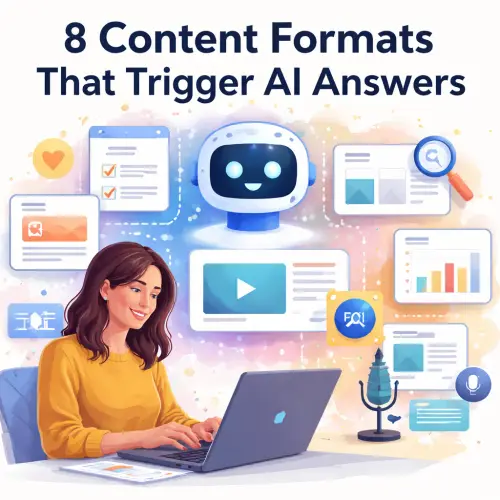
Content Formats That Trigger AI Answers Key Takeaways
AI-powered search engines like Google SGE, ChatGPT, and Bing AI increasingly rely on structured, semantic content to generate direct answers.
- Content Formats That Trigger AI Answers include FAQs, lists, tables, how-to guides, and structured data formats that AI models easily parse and extract.
- Optimizing for AI answer extraction requires clear headings, concise paragraphs, and semantic markup that aligns with user intent.
- Formats like comparison tables and step-by-step instructions perform exceptionally well across Google SGE, ChatGPT, and Bing AI because they provide ready-to-use answers.
Table of Contents
Introduction
Search behavior has changed. Users no longer scroll endlessly through results. Instead, they expect immediate, accurate, and structured answers—often delivered directly by AI systems. Platforms powered by artificial intelligence now summarize content, extract key insights, and present them instantly in search results.
This shift has given rise to AI Overviews, featured snippets, and zero-click searches, where users get what they need without visiting a website.
To remain visible, content creators must adapt. Traditional blog writing alone is no longer enough. What matters now is how information is structured, formatted, and presented for machine interpretation.
This is where content formats that trigger AI answers become critical.
This guide explains eight high-performing content formats that increase the likelihood of being selected by AI systems and featured in search summaries.
What Are AI Answers and Why Do They Matter?
AI answers are automatically generated responses created by search engines using machine learning models. These answers are pulled from multiple sources and synthesized into concise outputs.
Why they matter:
- Increase visibility without requiring clicks
- Establish authority in your niche
- Improve trust and credibility
- Drive indirect traffic and brand awareness
To appear in AI-generated results, content must be:
- Clear
- Structured
- Direct
- Contextually relevant
1. Question-and-Answer (Q&A) Format
The Q&A format is one of the most effective structures for AI extraction.
Why it works:
AI systems are trained to respond to questions. When your content mirrors that structure, it becomes easier for AI to extract and present answers.
Example:
What is AI Overview optimization?
AI Overview optimization is the process of structuring content so it can be easily extracted and summarized by AI-powered search systems.
Best practices:
- Use natural, conversational questions
- Provide direct answers immediately
- Keep answers concise (40–60 words ideal)
- Add supporting details after the main answer
Optimization tip:
Use variations of the same question:
- What is…
- How does…
- Why is…
2. List-Based Content
Lists are highly scannable and structured, making them ideal for AI extraction.
Why it works:
AI prefers content that is:
- Organized
- Easy to parse
- Clearly segmented
Example:
Top Benefits of AI Overview Optimization:
- Faster content discovery
- Increased visibility in search
- Improved user engagement
- Higher authority signals
Best practices:
- Use numbered lists for steps
- Use bullet points for features
- Keep items short and clear
- Maintain consistent formatting
3. Definition-Based Content
Definitions are among the most commonly extracted content types for AI answers.
Why it works:
AI systems prioritize clear explanations of concepts.
Example:
AI Overview:
AI Overview is a feature in search engines that summarizes information from multiple sources into a single, concise answer.
Best practices:
- Start with a clear definition
- Keep it under 50 words
- Avoid unnecessary complexity
- Use simple language
4. Step-by-Step Guides
Procedural content is highly valuable for AI systems.
Why it works:
Users frequently search for instructions. AI systems extract steps and present them directly.
Example:
How to Optimize Content for AI Answers:
- Identify user intent
- Structure content with headings
- Use clear definitions
- Add lists and summaries
- Optimize for readability
Best practices:
- Use numbered steps
- Keep steps actionable
- Avoid long paragraphs
- Use consistent formatting
5. Comparison Content
Comparisons help users make decisions quickly.
Why it works:
AI systems extract differences and similarities for quick answers.
Example:
AI SEO vs Traditional SEO:
| Feature | AI SEO | Traditional SEO |
|---|---|---|
| Focus | Answers | Rankings |
| Format | Structured | Keyword-based |
| Output | Summaries | Listings |
Best practices:
- Use tables when possible
- Keep comparisons simple
- Focus on key differences
- Avoid excessive detail
6. Summary Sections
Summaries help AI systems understand the core message of your content.
Why it works:
AI often extracts content from summaries to generate quick answers.
Example:
Summary:
AI Overview optimization focuses on structuring content in a way that allows AI systems to extract and present clear, concise answers.
Best practices:
- Place summaries at the beginning or end
- Keep them concise
- Highlight key points
- Avoid repetition
7. Conversational Content
Conversational tone aligns with voice search and AI interaction.
Why it works:
AI models are trained on natural language.
Example:
Instead of:
“AI Overview optimization improves visibility.”
Use:
“How can you improve visibility with AI Overview optimization? By structuring your content so AI can easily extract answers.”
Best practices:
- Use natural language
- Include follow-up questions
- Mimic real conversations
- Avoid overly formal language
8. Structured Data and Formatting
Structure is critical for AI readability.
Why it works:
AI relies on patterns and formatting to interpret content.
Key elements:
- Headings (H1, H2, H3)
- Bullet points
- Tables
- Short paragraphs
Best practices:
- Use clear headings
- Break content into sections
- Avoid large text blocks
- Maintain logical flow
How to Combine These Formats Effectively
The most successful content does not rely on one format alone.
Ideal structure:
- Definition
- Q&A section
- List
- Step-by-step guide
- Comparison
- Summary
This layered approach increases the chances of AI extraction.
Common Mistakes to Avoid
1. Overly complex language
AI favors clarity over complexity.
2. Lack of structure
Unorganized content is harder to extract.
3. Keyword stuffing
Focus on meaning, not repetition.
4. Long paragraphs
Break content into smaller sections.
Future of AI Content Optimization
AI search is evolving rapidly. Content strategies must adapt accordingly.
Emerging trends:
- Increased use of conversational queries
- More reliance on structured content
- Growth of zero-click searches
- Integration of voice and AI assistants
Practical Implementation Strategy
Step 1: Research user intent
Understand what users are asking.
Step 2: Choose the right format
Match content format to query type.
Step 3: Structure content clearly
Use headings and lists.
Step 4: Optimize for readability
Keep sentences simple and direct.
Step 5: Add summaries
Help AI extract key points.
Conclusion
Content creation is no longer just about writing—it is about structuring information for both humans and machines.
By using the eight formats discussed:
- Q&A
- Lists
- Definitions
- Step-by-step guides
- Comparisons
- Summaries
- Conversational content
- Structured formatting
you position your content to be selected by AI systems.
The goal is simple:
Make your content easy to understand, easy to extract, and easy to trust.
That is what triggers AI answers.
Frequently Asked Questions About Content Formats That Trigger AI Answers
What content formats trigger AI answers?
Content Formats That Trigger AI Answers include FAQs, listicles, tables, how-to guides, definitions, data statistics, comparison content, and structured snippets. These formats provide clear, extractable information that AI engines like Google SGE, ChatGPT, and Bing AI can parse for direct answers.
Which formats perform best for AEO and GEO?
FAQ and table formats perform best for Answer Engine Optimization (AEO) and Generative Engine Optimization (GEO). They provide explicit question-answer pairs and structured data, making them ideal for AI extraction. Listicles and how-to guides also perform well due to their clear sequence.
How do I structure content for AI-generated answers?
Structure content with clear H2 and H3 headings that match search queries. Use bullet points, numbered lists, and tables for data. Keep answers concise (30–60 words) in the first paragraph of each section. Use schema markup like FAQPage or HowTo to signal relevance to AI engines.
What type of content appears in AI overviews?
AI overviews typically feature content that is concise, factual, and structurally clear. FAQs, comparison tables, listicles with bolded keywords, and step-by-step instructions appear most frequently. Content with schema markup and semantic HTML has a higher chance of being selected.
How do AI engines extract content from pages?
AI engines use natural language processing to scan for heading hierarchies, list structures, table cells, and question-answer patterns. They prioritize content with clear semantic signals and avoid pages with heavy clutter, unrelated text, or poor structure.
What formats increase chances of appearing in AI answers?
Formats that increase AI answer visibility include FAQs, tables with clear headers, numbered lists, and structured data snippets. Content that directly answers user queries in the first 50–100 words of a section also performs well. Using schema markup further boosts chances.
How do I optimize content formats for ChatGPT?
Optimize for ChatGPT by using bullet points, numbered steps, and bolded key terms. Keep paragraphs short (2–3 sentences). Use clear headings and provide direct answers to common questions. ChatGPT prefers content that is easy to summarize without losing meaning.
What formats work best in Google SGE?
Content Formats That Trigger AI Answers in Google SGE include comparison tables, FAQ sections, and listicles with numbered items. Google SGE also favors content with high authority signals, such as backlinks from reputable sources and proper semantic structure.
How does Bing AI display content formats?
Bing AI often displays content in bullet lists, numbered steps, or inline citation formats. It extracts data from tables, FAQs, and fact-based content. Bing places emphasis on content that uses structured data and clear source citations.
What role do FAQs play in AI answers?
FAQs are crucial because they directly match the question-answer format AI models are trained on. They provide explicit pairings of queries and responses, making extraction straightforward. FAQs also help cover long-tail questions and improve content comprehensiveness.
How do list and table formats affect AI visibility?
Lists and tables significantly improve AI visibility by providing structured, scannable data. AI engines can easily extract individual items from lists and cells from tables. These formats reduce ambiguity and increase the likelihood of your content being selected for featured snippets and AI overviews. For a related guide, see 12 Content Optimization Tips for Featured Snippets and AI Answers.
What content structure improves AI indexing?
Content structure that improves AI indexing includes a clear hierarchy with H1, H2, H3 headings; concise paragraphs under each heading; use of bullet points and tables; and semantic HTML tags. Including schema markup like Article, FAQPage, or HowTo further aids indexing.
How to format content for zero-click results?
To format for zero-click results, place the direct answer in the first paragraph under a relevant H2 heading. Keep the answer under 50 words. Use bullet points or a table for supporting data. Ensure the answer is self-contained and does not require additional context.
What are common mistakes in content formatting for AI search?
Common mistakes include using vague headings, burying answers in long paragraphs, neglecting schema markup, overusing keywords, and failing to break content into scannable sections. Another mistake is not aligning the content format with user intent, which reduces relevance.
How to align content format with user intent?
Analyze search queries to determine intent: informational (use FAQ, definitions), transactional (use comparison tables, listicles), navigational (use structured snippets). Match the format to the query type. For example, “how to” queries work best with step-by-step guides.
Can I use multiple formats on one page for AI answers?
Yes, combining multiple formats—like a FAQ section, a comparison table, and a listicle—can increase the chances of your content being used for different types of queries. However, ensure the page remains focused and organized to avoid confusing the AI.
How often should I update content for AI relevance?
Update content every 6–12 months to keep statistics, examples, and references current. AI engines prefer recent data, especially for queries about trends, technology, or news. Regular updates also signal freshness to search algorithms.
Does content length affect AI answer extraction?
Content length affects extraction ability indirectly. Longer content with clear structure and well-defined sections can still be extracted effectively. However, short, focused answers are easier for AI to parse. Aim for a balance: comprehensive coverage with structured segments.
How do I measure if my content is triggering AI answers?
Monitor performance in Google Search Console for impressions on featured snippet queries. Use tools like Semrush or Ahrefs to track keyword rankings in AI overviews. Check GSC for zero-click result metrics and adjust your content formats accordingly. For a related guide, see Why International Brands Trust Filipino SEO Consultant Jin Grey in the AI Search Era.
What is the future of content formatting for AI search?
The future of content formatting for AI search will emphasize semantic richness, structured data, and modular content blocks. AI will favor content that can be easily broken down and reassembled into answers. Expected advancements include dynamic content formatting that adapts to different AI models’ extraction patterns.

I am a dedicated writer and researcher behind BecomingSEO, focused on creating clear, practical, and results-driven content in the field of search engine optimization and digital growth. With a strong interest in how content, data, and strategy intersect, I aim to simplify complex SEO concepts into actionable insights that businesses and individuals can apply immediately.
Through BecomingSEO, I share knowledge on search visibility, content strategy, and emerging trends, helping readers build a stronger online presence in an ever-evolving digital landscape. My work is grounded in continuous learning, analytical thinking, and a commitment to delivering content that is both informative and impactful.