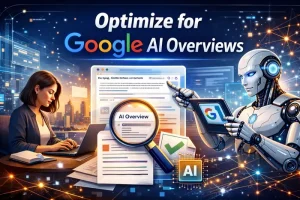
Google AI Overviews are AI‑generated summaries that appear at the top of some search results, answering questions directly and citing multiple web pages as sources. They’re built on the same index and ranking systems as classic search, but use AI to synthesize and present information in a more conversational, “instant answer” format.
In 2026, AI Overviews are one of the biggest shifts in how people experience search, and they’re already changing what “ranking” and “visibility” mean for SEOs and brands. This guide explains, in plain language, what AI Overviews are, how they work, and what they mean for white hat SEO.
Part 1: What Are Google AI Overviews?
AI Overviews are AI‑generated answer blocks that appear for many informational and complex queries.
In simple terms:
- Google’s AI scans multiple web pages about a topic.
- It generates a concise summary that answers the query.
- It displays citations—links to the sources used—so users can verify or read more.
According to Google’s AI features documentation, AI Overviews are designed to “help people get to the gist of a complicated topic or question more quickly, and provide a jumping‑off point to explore links to learn more.”
Key points:
- They appear above traditional organic results.
- They don’t replace blue links—but they do sit in front of them.
- They’re powered by Gemini and other internal systems layered on top of Google’s index.
For a more tactical angle on getting cited, see Optimize for Google AI Overviews.
Part 2: AI Overviews vs Traditional Search (and AI Mode)
AI Overviews vs Classic Search Results
Traditional search:
- Shows a ranked list of links with snippets.
- Users scan and choose which site to click.
AI Overviews:
- Show a synthesized summary answer at the top.
- Include a handful of cited sources as cards or inline links.
Research has found that:
- AI Overviews can appear for 30%+ of U.S. desktop keywords and a large share of informational queries.
- CTR on position #1 organic often drops when AI Overviews appear, as users find answers directly in the summary.
However, brands cited inside AI Overviews can see a visibility and trust boost—even when users don’t always click—because they’re presented as trusted sources in the answer itself.
AI Overviews vs AI Mode
Google now offers two related but distinct AI experiences:
- AI Overviews:
- Embedded at the top of standard search results.
- Quick, non‑interactive summaries with citations.
- AI Mode (Gemini‑powered):
AI Overviews are the “front door” AI experience inside regular search, while AI Mode is a deeper, chat‑style mode for users who want a full conversation rather than a single answer.
Part 3: How Google AI Overviews Choose Sources
Google doesn’t publish a complete ranking formula, but documentation and independent studies point to a few consistent patterns.
Sources in AI Overviews typically:
- Already rank reasonably well for some variant or related query (including “hidden” or synthetic queries generated by the AI).
- Provide clear, concise definitions or summaries near the top of the page.
- Use structured, scannable formatting: headings, lists, and short paragraphs.
- Demonstrate strong E‑E‑A‑T signals: real authors, credible entities, and trustworthy information.
Technical notes from SEO research:
- AI systems may expand the user’s original query into several internal queries and pick sources that rank well for those.
- Content doesn’t always need to be #1 for the original keyword to be cited in an Overview; it may rank well for one of those internal variations instead.
This is why white hat foundations—helpful content, E‑E‑A‑T, clear structure, and authority—are even more important in the AI era.
To strengthen these, use:
Part 4: Impact of AI Overviews on Traffic and SEO
AI Overviews change how organic traffic is distributed, but they don’t make SEO obsolete.
Key observed impacts:
- Position #1 isn’t what it used to be: Several studies report 20–30% average CTR drops for top organic results when an AI Overview is present.
- Visibility is more “winner‑takes‑more”: Sites that are cited in AI Overviews gain brand exposure and perceived authority, even if overall clicks per query are lower.
- Specialized, in‑depth content can benefit: Data suggests expert, niche resources often see increased visibility as AI favor authoritative sources for complex topics.
At the same time, some scenarios show potential 40–60% traffic drops for unprepared sites that rely heavily on generic content and legacy ranking advantages.
In practice, this means:
- Thin, generic content is riskier than ever.
- Strong entities (brands and authors) with clear expertise have more upside.
- SEO strategy must now consider both classic rankings and AI‑layer visibility.
Part 5: What AI Overviews Mean for White Hat SEO
From a white hat perspective, AI Overviews don’t change the principles—they raise the bar on applying them.
They make the following even more important:
- People‑first content: Content must satisfy real user needs, not just target keywords, aligning with Google’s helpful content guidance.
- E‑E‑A‑T: Experience, expertise, authority, and trust signals are more central than ever to being chosen as a source.
- Topical authority and clustering: AI prefers sites that show depth on a topic, not random one‑off posts.
- Clean technical and semantic structure: Semantic HTML, structured data, and performance make it easier for AI to parse and quote your content.
- Ethical link earning and off‑page reputation: Strong, relevant backlinks and brand mentions support your entity as a trusted source across both classic and AI search.
This is exactly the territory covered in:
Part 6: Where to Go Next (From “What” to “How”)
This article answers “What are Google AI Overviews and why do they matter?” If you’re ready for the “How do I actually optimize for them?”, your next stops should be:
- Optimize for Google AI Overviews — tactical steps to structure content, strengthen entities, and earn citations.
- SEO Copywriting for People‑First Content — write summaries and sections that AI can easily understand and quote.
- AI Content vs Human Content — build a safe hybrid workflow that supports AI‑era SEO without risking spam issues.
- SEO Analytics for Beginners — track how AI Overviews and AI search features are affecting your traffic and visibility.
AI Overviews are not the end of SEO; they’re a new layer on top of it. The sites that adapt their content and strategy to this layer—without abandoning white hat principles—will have a durable advantage in the AI‑driven search world.
About BecomingSEO: We provide practical, beginner‑friendly SEO education. Founded by James Cee Diaz, with contributions from expert practitioners including Jin Grey, strategist behind SEO Mafia Club.

Jin Grey is a senior SEO consultant and the founder of SEO Mafia, with over 18 years of experience engineering search growth for global brands. A recognized specialist in high-stakes verticals like iGaming, she blends technical site architecture with AEO, GEO, and NLP-driven content to build resilient, conversion-focused systems.
Known affectionately as “Manang” to her inner circle, Jin is a digital nomad and mentor who leads a global collective of verified specialists, bridging the gap between deep technical execution and sustainable business growth.