Search in 2026 doesn’t look—or behave—like it did a few years ago. AI Overviews are rewriting how users interact with results, Core Web Vitals still influence who gets visibility, and “local vs. global” has blurred into something more complex.
For international brands, that means one thing: SEO can’t be a loose collection of tactics anymore. It has to work as a system.
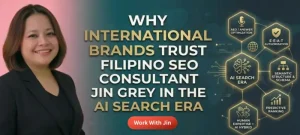
That’s the environment where Filipino Senior SEO Consultant and full‑stack strategist Jin Grey has built his practice. Based in the Philippines and working with clients across continents, he helps brands design search strategies that are semantic, technically resilient, AI‑aware, and built for long‑term growth—not just the next spike.
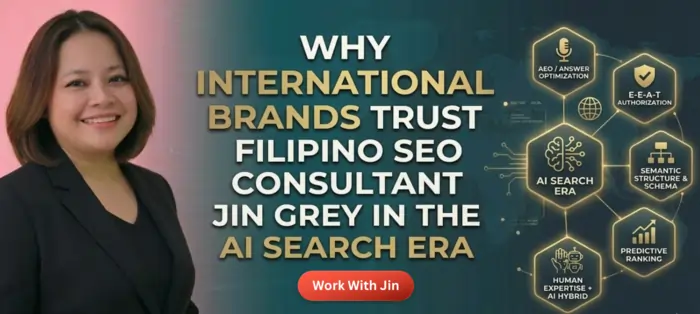
Here’s why international brands choose to work with him in the AI search era.
1. Full‑stack SEO leadership from a single consultant
Jin isn’t positioned as a narrow “implementer” or “content guy.” He acts as a full‑stack SEO consultant who can own the entire lifecycle of search:
- Discovery, audits, and diagnostics
- Strategic roadmapping over 3–12 months
- Implementation guidance with dev, content, and marketing teams
- Monitoring, iteration, and course‑correction as algorithms and AI surfaces evolve
For global organizations, this means one accountable Senior SEO Consultant who understands both technical constraints and business outcomes, instead of a patchwork of vendors each owning a tiny slice.
2. Semantic keyword research that maps markets, not just terms
In the AI search era, understanding how people search matters as much as what they search.
Jin’s keyword research process leans heavily on semantics and intent:
- Semantic and LSI‑style keyword expansion to capture the full language of a niche
- Long‑tail keyword strategy for depth, not just head‑term visibility
- Topical keyword clustering that organizes content around themes and entities
- Search‑intent‑driven keyword sets mapped to awareness, consideration, and decision stages
- Keyword mapping that assigns clear roles to URLs instead of stuffing terms everywhere
- Inputs from People Also Ask, related searches, and autocomplete patterns to mirror real behavior
The outcome is a topical map of the market, showing where the brand is strong, where it’s weak, and which content and features need to exist to close the gap.
3. On‑page SEO engineered for E‑E‑A‑T and AI‑shaped SERPs
On‑page SEO in 2026 is about clarity and trust—both for users and for AI systems that summarize, rank, and remix information.
Jin’s on‑page work typically includes:
- Meta titles and descriptions written around intent and click‑worthiness, not just keywords
- Internal linking structures that pass relevance and authority between key pages
- Schema markup and structured data that clarify entities, relationships, and context
- Page layouts that follow semantic SEO content structure (headings, sections, FAQs, entities)
- E‑E‑A‑T‑oriented content refinement to highlight real experience, expertise, authority, and trust signals
This makes pages more likely to rank traditionally while also becoming solid candidates for inclusion in AI Overviews and other AI‑driven answer formats.
4. AI SEO as leverage—human strategy as the differentiator
AI is now embedded in both search and content workflows, but how it’s used can either strengthen or weaken a brand.
Jin treats AI as a lever, not a replacement:
- Using AI to speed up research, outlining, and first‑draft creation
- Applying AI‑aware optimization to align with patterns that AI systems tend to surface
- Keeping all final decisions, edits, and fact‑checking under human control
He actively looks at AI Overviews keywords and triggers, but draws a clear line: AI is there to increase coverage and speed; human judgment protects accuracy, brand voice, and long‑term viability.
5. Technical SEO that removes growth‑killing friction
For many international sites, the biggest SEO problems are invisible to non‑technical teams: slow templates, bloated sitemaps, inconsistent signals, and fragile architectures.
As a technical SEO audit specialist, Jin focuses on removing that friction:
- Optimizing Core Web Vitals and overall performance across device types
- Ensuring mobile‑friendly implementations that match real user environments
- Fixing crawlability and indexation issues so important content is actually discoverable
- Cleaning up index bloat, thin pages, and duplicate content that dilute signals
- Re‑architecting internal links and URL structures so both crawlers and users can move logically
The goal isn’t perfection for its own sake; it’s a stable, efficient platform where content and links can perform instead of fighting underlying technical debt.
6. “Glocal” SEO: local search as a pillar of global expansion
For international brands, local SEO isn’t just about single locations—it’s about winning key cities and regions within a global footprint.
Jin designs GEO work around these “glocal” needs:
- Local and Maps optimization for priority cities and regions
- Google Business Profile optimization and maintenance at scale
- NAP consistency and citation building for multi‑location brands
- Geo‑targeted SEO campaigns that align with paid, offline, and partner activity
- Local pack and “near me” strategies for markets like London, New York, Manila, Singapore, and beyond
Instead of treating local SEO as an add‑on, he integrates it into the broader organic strategy so that global and local visibility reinforce each other.
7. Off‑page and link building designed for algorithm resiliency
In an AI‑driven, update‑heavy environment, how you earn links matters just as much as how many you earn.
Jin’s off‑page approach is built around white‑hat authority building and resiliency:
- Backlink profile audits and clean‑ups where legacy links are risky
- Competitor backlink analysis to identify realistic, high‑value targets
- Digital PR and content campaigns designed to earn coverage and citations, not just links
- Outreach‑based link building with strict relevance and quality thresholds
- Targeted link building for niche and product‑led sites where each placement can materially shift results
- Authority building that positions brands as trustworthy sources for both search engines and AI systems
A recurring theme here is algorithm resiliency—designing off‑page signals to support growth through updates instead of collapsing every time the rules shift.
8. AI‑first SEO strategy for an AI‑shaped search experience
Search results are increasingly mediated by AI: summaries, answer boxes, conversational follow‑ups, and blended result sets.
Jin factors this directly into his planning:
- Optimizing content and entities so they can be cited in Google AI Overviews
- Identifying and targeting query patterns that are likely to trigger AI‑generated responses
- Applying semantic SEO principles so content is structured, machine‑readable, and easy to reuse
- Designing experiences that account for how users consume AI answers, not just how they click on links
For international brands, this means building a presence where attention actually goes next, not just where it used to be.
9. One Senior SEO Consultant overseeing the system, not just a tactic
What ultimately sets Jin apart for international companies is ownership.
He operates as an SEO consultant for multiple tasks and an end‑to‑end system designer. Keyword research, on‑page work, AI SEO, GEO, technical SEO, off‑page, and backlinks aren’t treated as separate projects—they’re components of a single, coherent architecture.
For teams that are tired of fragmented efforts and reactive firefighting, this model offers something different: a Senior SEO Consultant focused on system design, algorithm resiliency, and sustainable growth in an AI‑shaped search landscape.
FAQ
General & Strategic SEO
1. What does a “Full-Stack SEO Consultant” actually do? In Jin’s practice, it means owning the entire vertical: from the code (Technical) and the meaning (Semantic/On-page) to the reputation (Off-page/Links) and the AI integration. You get one architect instead of four siloed specialists.
2. Why focus on “System Design” instead of just “SEO Tasks”? Individual tactics (like buying a link or writing a blog post) are fragile. A system ensures that every technical fix supports a content cluster, which in turn earns high-quality links, creating a self-reinforcing loop of authority.
3. How has SEO changed since the “AI Search Era” began? Search is no longer just a list of blue links; it’s an answer engine. In 2026, SEO is about being the source that AI Overviews cite and the entity that Google trusts to provide “Information Gain” that AI cannot replicate.
4. Does “International SEO” just mean translating content? No. It involves “Glocal” strategy—managing hreflang tags for technical clarity, understanding regional search intent (which varies by culture), and building local citations in specific global hubs like London, NYC, or Singapore.
AI & Semantic Search
5. What is an “AI-Aware” search strategy? It’s a strategy that optimizes for how LLMs (Large Language Models) crawl and summarize data. This includes using specific Schema markup and structured data so AI systems can easily “read” and attribute your brand as an authority.
6. Can Jin’s strategies help my brand appear in AI Overviews? Yes. By using semantic keyword mapping and answering specific “intent-driven” queries with high E-E-A-T signals, your content becomes a primary candidate for AI-generated summaries and answer boxes.
7. Does Jin use AI to write content? Jin uses AI as a lever, not a replacement. AI assists with data analysis, outlining, and initial drafts to increase speed, but a human expert always performs the final edit to ensure brand voice, factual accuracy, and unique insight.
8. What is “Semantic Keyword Research”? It goes beyond “exact match” terms. It’s about building a topical map that covers a subject’s entire ecosystem (entities, LSI terms, and user questions) so Google views you as a subject matter expert, not just a keyword optimizer.
Technical & On-Page SEO
9. What is a “Technical SEO Audit Specialist”? Someone who looks under the hood at “growth-killers” like crawl budget waste, JavaScript rendering issues, and Core Web Vitals. Jin identifies the friction points that prevent your content from being indexed or ranked.
10. Why are Core Web Vitals still important in 2026? User experience is a non-negotiable ranking factor. If a site is slow or unstable on mobile, Google’s algorithms—and AI systems—will prioritize faster, more reliable competitors to protect their own user retention.
11. What are “E-E-A-T signals” in On-Page SEO? Experience, Expertise, Authoritativeness, and Trustworthiness. Jin refines content to highlight real-world credentials, author bios, and verified data—elements that AI-generated “fluff” content cannot easily fake.
12. How does Schema Markup help international brands? It acts as a “translator” for search engines. It explicitly tells Google who you are, what you sell, and which regions you serve, reducing the risk of your content being misinterpreted in global markets.
Off-Page & Authority Building
13. What is “Algorithm Resiliency” in link building? It means building a backlink profile that doesn’t rely on “hacks” or low-quality directories. By earning links from high-authority, relevant industry sites, your rankings are less likely to crash during major Google core updates.
14. Does Jin handle “Digital PR”? Yes. Modern off-page SEO is essentially Digital PR. It’s about creating “link-worthy” assets and performing outreach to journalists and niche influencers to earn citations that drive both traffic and authority.
15. Is “White-Hat” SEO still effective? In 2026, it is the only sustainable way. Google’s AI-driven spam detection is now so advanced that “black-hat” shortcuts are caught almost instantly, leading to permanent domain suppression.
Local & “Glocal” SEO (GEO)
16. What is “GEO” (Generative Engine Optimization)? GEO is the evolution of local search. It involves optimizing your brand’s footprint so that when users ask AI tools “Where is the best [service] in [City]?”, your brand is the top recommended entity.
17. Can a consultant in the Philippines manage SEO for a brand in New York? Absolutely. With a “Glocal” approach, Jin uses localized data, GPS-simulated search results, and NAP (Name, Address, Phone) consistency tools to manage a brand’s local presence from anywhere in the world.
Working with Jin Grey
18. Why do international brands choose a consultant over a large agency? Direct access to seniority. Large agencies often pitch with their “A-team” but hand the work to juniors. With Jin, you are working directly with the Senior Strategist who is actually executing the work.
19. How long does it take to see results in the AI search era? While technical fixes can show impact in weeks, a full systemic SEO overhaul typically takes 3 to 6 months to show significant, sustainable growth in competitive international markets.
20. What is the typical engagement model? Jin typically works on a 3 to 12-month strategic roadmap, providing end-to-end guidance, implementation oversight, and monthly performance iterations to ensure the brand stays ahead of algorithm shifts.
James Cee Diaz | Web Dev Technical SEO & Search Strategist
Most SEOs find problems they can’t fix; most developers build sites that can’t rank. I bridge that gap. I engineer search-ready infrastructure for high-stakes iGaming and affiliate markets—ensuring your architecture is optimized to win before the first word of content is even written.