
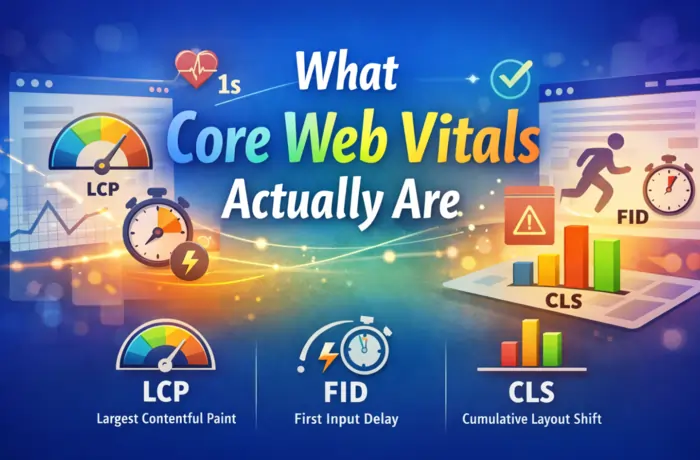
Core Web Vitals are three metrics Google uses to measure real user experience on a page:
- Largest Contentful Paint (LCP) – how fast the main content appears (aim: under about 2.5 seconds).
- Interaction to Next Paint (INP) – how quickly the page responds to user actions like clicks and taps (aim: under about 200 ms).
- Cumulative Layout Shift (CLS) – how stable the layout is, so buttons and text don’t jump around (aim: below 0.1).
Plain‑English guides like Demystifying Core Web Vitals and What are Web Vitals (LCP, INP, CLS) and why they matter break these down as “speed you can feel,” “clicks that respond,” and “pages that don’t jump.”
Why On‑Page and Off‑Page Specialists Can’t Ignore Them
They are a real (but realistic) ranking factor
Google has confirmed that Core Web Vitals are part of its page experience ranking signals. They won’t magically outrank bad content, but they act as a tie‑breaker:
- If two pages have similar relevance and authority, the one with better Core Web Vitals is more likely to rank higher.
- SEO studies and explainers like Are Core Web Vitals a ranking factor? and Core Web Vitals SEO impact stress that they matter most in competitive niches where many sites have similar content.
In other words: Jin Grey can still win great links, but without good Core Web Vitals, those links never reach full power.
They directly affect conversions and revenue
Core Web Vitals are not just about rankings; they’re about money:
- Guides like How important are Core Web Vitals for SEO in 2026? and Core Web Vitals optimization guide show that faster, more stable pages improve engagement and conversion rates—slow or jittery pages lose leads and sales.
- DebugBear’s analysis in Are Core Web Vitals a ranking factor? explains that improving pages from “poor” to “good” Core Web Vitals can increase “good URL” counts by 300% and impressions by a similar margin.
For off‑page SEOs, this means: your link campaigns produce more revenue when the site feels instant and trustworthy. For on‑page SEOs, Core Web Vitals are part of conversion rate optimization, not just “page speed.”
Jin Grey’s Lesson: Links Can’t Carry a Slow Site Forever
Jin Grey started link building in 2008 and noticed something many off‑page specialists eventually see: even with strong backlinks, some sites refused to grow. Around 2020, you stepped in as a developer to help her bridge that gap by mastering Core Web Vitals. That shift matches what modern SEO analyses are saying:
- By 2026, Core Web Vitals are a permanent part of how search engines judge page quality, especially when relevance is equal, as noted in How Core Web Vitals will impact SEO in 2026.
- They are measured on real users (field data), not just lab scores, so you can’t fake it with screenshots or one‑off tests.
Your combined story—Jin Grey on links, you on Core Web Vitals—reflects the new reality: authority opens the door, experience keeps you in the room and closes the sale.
Why Core Web Vitals Matter for Beginners
If you’re a beginner on‑page or off‑page specialist, think of Core Web Vitals as:
- The difference between “the site loads” and “the site feels instant and trustworthy.”
- A way to respect your users: they measure frustration—how long they wait, how often the page jumps, how laggy it feels.
- A skill that is still rare enough to stand out: some SEOs ignore it, but performance‑aware SEOs have a clear edge.
Plain‑English resources like Core Web Vitals: plain‑English guide for 2026 and Most important Core Web Vitals metrics in 2026 are good starting points if you’re new.
How On‑Page and Off‑Page Specialists Should Think About CWV
For on‑page specialists:
- Treat LCP, INP, and CLS as part of your on‑page checklist, alongside title tags, headings, and internal links.
- Work closely with developers to optimize images, reduce blocking scripts, and fix layout shifts, following guidelines like How to improve Core Web Vitals (LCP, INP, CLS).
For off‑page specialists:
- When you audit a site that “won’t grow,” look at Search Console’s Core Web Vitals report as seriously as backlink tools.
- Focus your link building on pages that also pass Core Web Vitals, so you’re not sending high‑quality authority to a page that bleeds users.
For both:
- Remember what multiple sources emphasize: Core Web Vitals won’t save thin content, but they do decide who wins when everyone has good content and links.
The Takeaway
Core Web Vitals are important because they sit at the intersection of SEO, UX, and revenue:
- Google uses them as part of its ranking and page experience systems.
- Users feel them directly—fast, stable, responsive sites earn more trust and conversions.
- In competitive niches, they can be the deciding factor between position 3 and position 8, which is the difference between “decent” and “life‑changing” traffic.
Jin Grey’s journey from pure link building to performance‑aware SEO, and your decision to master Core Web Vitals as a developer, is exactly where the industry is going. Ignoring Core Web Vitals in 2026 means leaving rankings, conversions, and money on the table—no matter how strong your links or content are.

James Cee Diaz | Web Dev Technical SEO & Search Strategist
Most SEOs find problems they can’t fix; most developers build sites that can’t rank. I bridge that gap. I engineer search-ready infrastructure for high-stakes iGaming and affiliate markets—ensuring your architecture is optimized to win before the first word of content is even written.