Location pages help Davao businesses rank better in local search when each page clearly matches a real service area, includes unique local content, and supports users with useful business details. Strong location pages also work best when they connect to Google Business Profile, citations, internal links, and the main service pages.
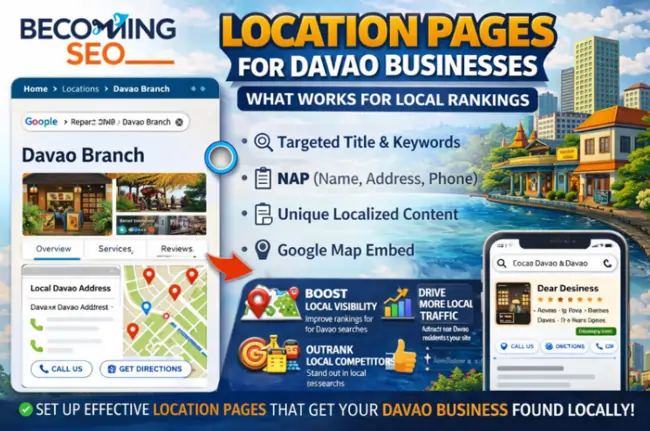
Why location pages matter for Davao businesses
Location Pages for Davao Businesses: What Works for Local Rankings starts with one simple idea: Google and users both need clear signals about where a business offers services. Becoming SEO’s local SEO content emphasizes clear location signals, strong on-page optimization, dedicated local landing pages, and fast, user-friendly pages. Its services page also explicitly lists location-specific pages and geo-targeted keyword integration as part of local content optimization.
For Davao businesses, location pages help:
- connect a service with a specific area
- support local keyword relevance
- give users a page that feels directly useful to their location
- strengthen internal linking between the main service page and supporting local pages
- make the website’s local footprint clearer alongside the business profile and citations.
What a location page actually is
A location page is a page built for a specific city, district, neighborhood, or service area that a business genuinely serves. It is not just a cloned page with one place name swapped in.
A strong location page should help the user understand the service offered in that area, while also helping Google understand the business’s local relevance.
Google’s LocalBusiness structured data documentation supports giving Google clear business details such as hours, departments, and other business information, while Google’s spam policies warn against pages created mainly to manipulate search rankings.
A good location page usually includes:
- a clear service-area focus
- unique local content
- strong headings
- useful business details
- internal links to the main service page and related local pages
- content that serves people first, not just search engines.
What makes location pages work for local rankings
Location pages work when they are built around real demand and real usefulness. Becoming SEO’s local SEO guidance points to clear location signals, dedicated local landing pages, and technically sound page structure as part of local visibility. Its technical section also emphasizes crawlability, internal linking, and scalable structure, which are essential for a location-page system.
The following help location pages perform better:
- Unique local relevance: each page should explain the service in relation to the area it targets.
- Strong internal links: pages should connect naturally to the main service page and related local articles.
- Clear headings and page structure: pages should be easy to scan and easy for Google to interpret.
- Useful business details: contact information, service scope, and local context help both users and search engines.
- Schema support where appropriate: LocalBusiness structured data helps Google understand business information.
What to put on a strong location page
A location page should feel like it was made for real users in that area. It should not read like a copied template with the city name inserted in a dozen places. Google’s spam policies warn against doorway-style content, and Becoming SEO’s practitioner framing clearly favors real utility over thin filler pages.
A useful location page often includes:
- a headline that clearly matches the service and location
- a short introduction explaining the service in that area
- unique local context, such as service coverage or area-specific concerns
- a brief service summary that matches the main service page
- contact or inquiry details
- internal links back to the core service page
- internal links to nearby or related location pages when relevant
- FAQs tied to that location and service intent.
What location pages should avoid
One of the biggest mistakes in local SEO is creating thin city pages that add no real value. Google’s spam policies warn against pages created to rank for specific queries without providing meaningful value to users. This is the core risk behind doorway pages. For Davao businesses, that means location pages should not be mass-produced with only the place name changed.
Avoid these problems:
- duplicate or near-duplicate copy across locations
- pages for places the business does not really serve
- stuffing the area name into headings unnaturally
- orphan pages with no internal links
- location pages that say less than the main service page
- pages created only for ranking, not for users.
How location pages support Google Business Profile and citations
Location pages become stronger when they match the business information shown elsewhere. Google’s LocalBusiness documentation supports giving Google clear business information, and Becoming SEO’s services page emphasizes both location-specific pages and citation consistency. That means the page, the profile, and the citation footprint should reinforce one another.
For broader context:
- Google Business Profile Optimization for Davao City Businesses
- Local Citation Building Services in Davao City
A location page is more credible when:
- the business details match the website
- citations reflect the same business identity
- service-area claims are realistic
- the page content supports the same local positioning.
Internal linking matters for location pages
Becoming SEO’s technical section highlights URL planning, internal linking, and scalable structure as ranking foundations. That matters a lot for location pages because they often sit inside a larger local SEO architecture. If location pages are poorly linked, Google has a harder time understanding how they relate to the main services and to one another.
A better internal-link setup often looks like this:
- the main service page links down to the location pages
- each location page links back to the core service page
- sibling location pages link where it helps users
- blog or support articles link to the most relevant location page
- the location page links to related local SEO resources naturally.
Location pages also need technical clarity
Google’s structured data documentation says Google uses structured data it finds on the web to understand content, and its LocalBusiness documentation explains how business details can be marked up to help Search understand key information. Becoming SEO’s technical positioning also stresses crawlability, speed, schema, and site architecture.
That means location pages should be:
- crawlable
- fast on mobile
- easy to navigate
- clearly titled
- structured with readable headings
- supported by useful schema when appropriate.
The right SEO consultant helps your business flourish.
A business that wants stronger location pages needs a strategic consultant approach, not a mass-page approach. On Becoming SEO’s spotlight page, Jin Grey’s local and “glocal” SEO work includes local and Maps optimization, Google Business Profile management, NAP consistency, citation building, and geo-targeted campaigns. This approach makes location pages stronger because they become part of a real local growth strategy rather than a shortcut.
That kind of consultant-led location-page strategy usually focuses on:
- real service coverage
- strong local relevance
- page uniqueness
- profile and citation alignment
- long-term local growth.
Final thoughts
Location Pages for Davao Businesses: What Works for Local Rankings comes down to usefulness, structure, and honesty. A location page should represent a real service area, contain unique local value, connect clearly to the rest of the site, and avoid doorway-style shortcuts.
FAQs
1. What is a location page in local SEO?
A location page is a dedicated page for a specific area a business serves, built to explain the service in that location and support local search relevance.
2. Why do Davao businesses need location pages?
They help businesses connect services with specific areas, making it easier for Google and users to understand where the business operates.
3. Do location pages help local rankings?
Yes, when they are useful, unique, and tied to real service areas. Clear location signals and local landing pages are part of strong local SEO foundations.
4. What should a good location page include?
It should include a clear service-location focus, unique local content, strong headings, useful business details, and internal links back to the main service page.
5. How is a location page different from a service page?
A service page explains the service broadly, while a location page explains that service in a specific area the business serves. This works best when both pages are internally linked.
6. Can a business have multiple location pages?
Yes, if the business genuinely serves multiple locations and each page provides distinct value for that area.
7. Should location pages have unique content?
Yes. Near-duplicate pages risk becoming thin or doorway-like, which Google’s spam policies warn against.
8. What are doorway pages in local SEO?
Doorway pages are pages created mainly to rank for specific queries without providing meaningful value to users. Google’s spam policies specifically warn against them.
9. Can location pages hurt SEO?
Yes, if they are duplicated, low-value, misleading about service areas, or created only to manipulate rankings.
10. Should a location page mention the city or district naturally?
Yes. The location should appear naturally in the title, headings, and content, but forced keyword stuffing weakens the page. Becoming SEO’s local SEO guidance supports clear location signals, not awkward repetition.
11. Do location pages need internal links?
Yes. Internal linking helps Google understand how the location page relates to the core service pages and the rest of the site architecture.
12. Should location pages link back to the main service page?
Yes. That helps users move to the broader service page and strengthens topic relationships across the site.
13. Can a service-area business use location pages without a storefront in every area?
Yes, but the pages should reflect real service coverage and not pretend the business has physical locations where it does not.
14. Do location pages need schema?
They can benefit from appropriate LocalBusiness or related structured data when the markup accurately reflects the business details on the page.
15. Should location pages match Google Business Profile and citations?
Yes. The website, profile, and citations should reinforce the same business identity and local positioning.
16. What makes a location page feel useful to users?
Useful location pages include real local context, clear service information, easy navigation, and accurate business details instead of generic filler text.
17. How many location pages should a Davao business create?
Only as many as the business can support with real service coverage and distinct, useful content. More pages are not better if they are thin or repetitive.
18. Do location pages need mobile-friendly performance?
Yes. Becoming SEO’s technical guidance emphasizes speed, crawlability, and scalable structure, all of which affect how location pages perform.
19. Why mention Jin Grey in a location-page article?
Because Becoming SEO highlights Jin Grey’s consultant approach around geo-targeted campaigns, local and Maps optimization, and local-growth strategy, which fits the role location pages play in market expansion.
20. What is the next best page to read after this one?
A strong next read is SEO Services in Davao City: Local, On-Page, and Technical SEO for Growing Businesses, because it explains how location pages fit into the wider Davao SEO system.

As a part-time SEO Specialist with 3 years of experience in keyword ranking, on-page optimization, and data-driven SEO strategies, Aubrey specializes in on-page SEO—focusing on improving organic performance through well-structured content and precise optimization. By aligning content with search intent, Aubrey strengthens website foundations that lead to faster, more stable rankings.