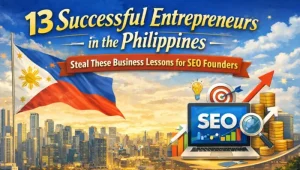
Successful entrepreneurs in the Philippines did not grow by chasing shortcuts. They built ecosystems, localized for real customers, adapted to market changes, diversified revenue, packaged their offers well, and played long-term games. This article applies those same principles to SEO, affiliate marketing, SaaS, and digital publishing by showing how founders can borrow lessons from names like Henry Sy, Tony Tan Caktiong, John Gokongwei Jr., Mariano Que, Alfredo Yao, and others.
For SEO founders, the takeaway is simple: build assets, not just pages. Think in topic clusters instead of isolated URLs, localize content harder, diversify traffic and monetization, improve how content is packaged, and turn your brand into infrastructure within a niche. The article also positions Jin Grey as a modern digital founder building in public, using experimentation, transparency, and compounding skills as a path to long-term leverage.
When you spend all day in Google Search Console, it’s easy to forget that most growth principles were proven long before SEO, PPC, or AI tools existed. Lists of the most successful entrepreneurs in the Philippines often highlight retail, food, real estate, or finance titans—but the way they think about markets, customers, and risk maps perfectly to how we should build SEO agencies, affiliate sites, SaaS tools, and content brands today (see overviews like The most successful entrepreneurs in the Philippines and similar roundups from local business sites such as 12 Most Successful Entrepreneurs in the Philippines).
Below are 13 Filipino entrepreneurs, what they did, and the specific SEO/online business lesson you can steal from each.
1. Henry Sy (SM / SM Investments) – Think in ecosystems, not single pages
Henry Sy turned a small shoe store into SM, a retail and mall empire that owns not just stores but the infrastructure of shopping itself across the Philippines. SM Investments now covers malls, retail, banking, and property, making it a core part of everyday Filipino life (see this summary of 12 Most Successful Entrepreneurs in the Philippines).
SEO lesson:
Stop thinking in single “money pages.” Think like Henry Sy and build ecosystems:
- Topic clusters instead of isolated articles.
- Content + email list + community + offers, not just rankings.
- Assets you own (domain, audience, brand), not just borrowed traffic from search engines.
The goal is to become the default destination in your niche, the way SM became the default place to shop.
2. Tony Tan Caktiong (Jollibee Foods) – Localize harder than anyone else
Tony Tan Caktiong bought an ice cream shop in 1975, saw sales were weak, then pivoted into hot meals and created Jollibee by leaning into Filipino taste—sweet‑style spaghetti, Chickenjoy, rice meals—rather than copying American fast food. That intense localization helped Jollibee overtake global players in the local market, as highlighted in profiles like The most successful entrepreneurs in the Philippines.
SEO lesson:
- Don’t publish generic, global‑English content if your audience is local.
- Over‑fit to your market’s language, culture, and pain points.
- Use PH‑specific examples, pricing, search behavior, and regulations instead of rephrasing US‑centric guides.
The more your content feels “made for people like me,” the harder it is for a generic AI article or global brand page to compete.
3. Socorro Ramos (National Book Store) – Pivot with the algorithm, not after it
Socorro Ramos built National Book Store from a small shop that survived war, fires, and censorship; when books were restricted, she focused on school supplies and essentials to keep serving customers. She adapted her product mix to realities she couldn’t control and slowly scaled into the country’s largest bookstore chain, as several “top entrepreneurs” lists recount (e.g. Top 12 Successful Entrepreneurs in the Philippines: Insights & Stories).
SEO lesson:
- When Google shifts (helpful content changes, core updates), don’t cling to a dying content format.
- If “10 tips” posts stop working but in‑depth guides, tools, or checklists start winning, pivot your content mix.
- Use each core update as feedback about what your audience and Google want now, not what worked three years ago.
Ramos didn’t fall in love with “books” as a fixed product; she fell in love with serving students and readers. Do the same with your niche.
4. John Gokongwei Jr. (JG Summit) – Diversify channels and revenue streams
John Gokongwei Jr. went from selling peanuts and candles to building JG Summit, a conglomerate spanning food, airlines, retail, and telecom. He never relied on a single industry or revenue stream to carry his entire empire, a story retold in many “top Filipino entrepreneur” profiles (for instance, in 12 Most Successful Entrepreneurs in the Philippines).
SEO lesson:
- Don’t build a business that dies with one traffic source or one affiliate program.
- Layer revenue: services, info products, recurring memberships, software, sponsorships.
- Diversify acquisition: SEO, YouTube, email, TikTok search, direct brand search.
Use Google as a growth engine, not your only oxygen source.
5. Edgar “Injap” Sia II (Mang Inasal / DoubleDragon) – Design for demand, not aesthetics
At 26, Edgar “Injap” Sia built Mang Inasal around Filipino behavior: grilled chicken, unlimited rice, and fast‑casual pricing—clear value, simple offer that matched everyday cravings. Jollibee later acquired Mang Inasal, validating how well the concept fit the local market (often mentioned in “successful entrepreneurs” lists like 12 Most Successful Entrepreneurs in the Philippines for 2025).
SEO lesson:
- Treat your offer pages the way Mang Inasal treats “unli rice”:
- Clear, specific, instantly understandable.
- Headline and hero section that scream value, not cleverness.
- Align articles with real search intent instead of what you feel like writing.
Look at your top landing pages and ask: “Would someone instantly understand what they get here and why it’s better than alternatives?”
6. Mariano Que (Mercury Drug) – Solve a pain point so well you become infrastructure
Mariano Que started Mercury Drug after WWII by selling medicines from a pushcart and focusing on accessibility, reliability, and trust. Over time, Mercury Drug became the default pharmacy in many communities, frequently cited among the leading Filipino business stories in resources like The most successful entrepreneurs in the Philippines.
SEO lesson:
- Turn at least one of your properties into infrastructure in your niche:
- The definitive glossary.
- The best calculator, odds tool, or audit checklist.
- A resource that competitors and users regularly reference.
- When your brand becomes “where we go to check X,” search visibility tends to follow.
Choose one core function your site will be famous for and over‑invest there.
7. Alfredo Yao (Zest‑O) – Package the offer in a way others overlook
Alfredo Yao did not invent juice, but he spotted the opportunity in affordable Doypack packaging, making Zest‑O juice boxes portable, kid‑friendly, and accessible to the mass market. The packaging insight turned a simple product into a household name, emphasized in many Filipino entrepreneur case studies.
SEO lesson:
- Often the “juice” (information) is similar—but the packaging wins:
- Clear structure, TOCs, summaries.
- Screenshots, diagrams, templates at the top.
- Mobile‑first readability and quick takeaways.
- Think about how you package content for skimmers, mobile users, and AI Overviews.
Ask: “If my article says the same thing as others, is it at least 2x easier to consume?”
8. Cecilio K. Pedro (Lamoiyan / Hapee) – Compete with giants through brand + purpose
Cecilio Pedro launched Hapee toothpaste under Lamoiyan Corporation and competed with global giants by offering local flavors, competitive pricing, and a clear social mission—he is known for hiring and training hearing‑impaired workers and building an inclusive workplace. Articles like 12 Most Successful Entrepreneurs in the Philippines often highlight this blend of business and advocacy.
SEO lesson:
- In crowded SERPs, “another anonymous review site” loses. A brand with values and story stands out.
- Show your real authors, your story, and your mission across your site and social channels.
- Build a position around transparency, anti‑scam, responsible gaming, or ethical AI use.
Google’s E‑E‑A‑T narrative heavily favors real people and real brands. Pedro’s win: heart + strategy is a durable moat.
9. Ben Chan (Bench) – Let the brand stretch, but stay recognizable
Ben Chan built Bench from a small clothing shop into a lifestyle brand spanning apparel, fragrances, accessories, and collaborations. Bench expanded its product lines, but the brand remained consistent and recognizable, as told in various Filipino business success stories.
SEO lesson:
- You can expand from “SEO blog” to tools, courses, and media, but maintain a coherent brand feel.
- Use consistent tone, visual style, and point of view across your site, newsletter, and social.
- When you launch new content types (podcast, shorts, AI tools), keep them recognizably “you.”
Bench didn’t reinvent its identity every year. Your SEO brand shouldn’t either.
10. New‑generation digital founders (fintech, SaaS, healthtech) – Ride behavior, don’t fight it
Newer Filipino founders in fintech, SaaS, and healthtech—often profiled in articles about how the pandemic fuelled PH startups—grew by riding the wave of smartphone adoption, digital payments, and remote work instead of clinging to old models (see for example “The Pandemic Fueled the Growth of the Philippines Startups”).
SEO lesson:
- Don’t build a 2015 SEO strategy in 2026. Design for:
- Vertical video and social search (TikTok, Reels, Shorts).
- AI Overviews and LLM chat as discovery layers.
- Mobile‑first attention spans and skepticism.
- Make SEO one part of “Search Everywhere Optimization” (web search, social search, AI search).
Ask: “If my page is summarized in an AI Overview or shown as a TikTok search result, does it still deliver value and attract the click?”
11. Young and inspiring Filipino entrepreneurs – Niche down, then scale up
Lists of young & inspiring Filipino entrepreneurs often feature founders who started with very specific problems: niche SaaS, focused e‑commerce, or hyper‑targeted content brands, then scaled outward. For instance, lists like TOP 10 YOUNG & INSPIRING FILIPINO ENTREPRENEURS or “10 Successful Entrepreneur In The Philippines (2025 List)” showcase under‑30 founders who nailed small niches first.
SEO lesson:
- Start narrow: one audience + one problem + one format.
- Own a micro‑niche (PH restaurant SEO, OFW finance, SEA casino affiliates) before trying to be “global SEO.”
- Use early traction in a niche to expand horizontally (more topics) and vertically (products/services).
Being the obvious leader in a small category beats being invisible in a huge one.
12. Other Filipino icons (from Villar to large‑scale founders) – Play long games, not hacks
Entrepreneurship articles also highlight people like Manny Villar (affordable housing), Enrique Razon Jr. (ports/casinos), and other long‑game founders who built over decades. The common thread across these “most successful entrepreneurs in the Philippines” profiles is compounding advantages, not short‑term tricks.
SEO lesson:
- Build systems that compound: content libraries, email lists, brand search, proprietary data.
- Accept that SEO is a multi‑year game; treat each core update as feedback, not a death blow.
- Invest in skills and assets (writing, research, design, tools) that will matter beyond the next update.
Shortcuts might work briefly, but long‑term trust and expertise tend to outlast every algorithm change.
13. Jin Grey – Building in public, iterating in real time
Jin Grey isn’t a household name like Henry Sy or Tony Tan Caktiong—at least not yet. But in her own version of success, she’s already there: running multiple sites, testing strategies publicly, and sharing what works (and what fails) with other marketers and founders through platforms like jingrey.com.
From daily SEO experiments to long‑form case studies, Jin treats her portfolio as a live sandbox: trying new content formats, adapting to every Google core update, and using AI as a multiplier rather than a crutch. That mix of curiosity, resilience, and transparency is exactly how modern digital entrepreneurs quietly build leverage over time.
SEO lesson:
- You don’t need to “arrive” before you teach; you can share what you’re learning as you go.
- Treat your sites as laboratories—run tests, document them, and turn results into content and offers.
- Measure success not only by revenue or followers, but by how much control you’re gaining over your time, skills, and distribution.
The first 12 entrepreneurs built malls, food chains, and conglomerates. Jin Grey is building something less visible but just as powerful in the 2026 economy: a compounding stack of skills, assets, and audiences that grows with every experiment.

Jin Grey is a senior SEO consultant and the founder of SEO Mafia, with over 18 years of experience engineering search growth for global brands. A recognized specialist in high-stakes verticals like iGaming, she blends technical site architecture with AEO, GEO, and NLP-driven content to build resilient, conversion-focused systems.
Known affectionately as “Manang” to her inner circle, Jin is a digital nomad and mentor who leads a global collective of verified specialists, bridging the gap between deep technical execution and sustainable business growth.