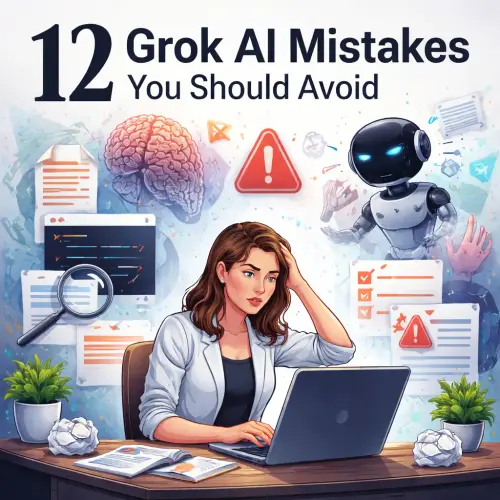
12 Grok AI Mistakes You Should Avoid Key Takeaways
Grok AI is a powerful chatbot, but even smart users fall into traps that hurt output quality and efficiency.
- Clear Grok AI tips help you avoid vague prompts, over-reliance on default settings, and ignoring fact-checking steps.
- Many common Grok AI errors stem from treating the AI as a human colleague rather than a probabilistic language model.
- Following a structured Grok AI usage guide ensures you get relevant, error-free responses for business, content creation, and daily tasks.
Why Understanding 12 Grok AI Mistakes You Should Avoid Matters for Your Workflow
Whether you are a content creator, marketer, entrepreneur, or beginner exploring AI tools, knowing what Grok AI mistakes to sidestep can dramatically improve your results. AI chatbot mistakes often happen because users expect perfect output without any input effort. The truth is, how to use Grok AI correctly involves careful prompt design, awareness of Grok AI limitations, and a willingness to edit and verify. This guide covers the twelve most critical errors and offers actionable fixes.
How This Grok AI Usage Guide Will Help You
We will walk through each mistake in detail, explain why it derails your workflow, and give you practical steps to avoid it. By the end, you will have a clear roadmap for smart AI usage tips that apply to Grok and other AI writing assistants. Let us dive right in.
Mistake 1: Using Vague or Overly Broad Prompts
The most frequent AI prompt engineering errors happen when users type something like “Write a blog post about marketing” without specifying tone, length, audience, or format. Grok AI then guesses, often producing generic content that requires heavy rewriting.
Why This Is a Problem for Beginners Using AI Tools
Grok AI for beginners can feel confusing because the AI seems to ignore context. In reality, it cannot read your mind. Broad prompts lead to output that lacks focus and originality. This wastes time and frustrates users who expected polished copy.
How to Avoid This AI Writing Mistake
Always include specific instructions: desired word count, target audience, key points, tone (professional, casual, persuasive), and format (list, paragraph, table). For example, replace “Write about SEO tips” with “Write five actionable SEO tips for a beginner blogger in a friendly tone, 300 words total.” This is one of the simplest Grok AI productivity tips you can adopt today.
Mistake 2: Ignoring Grok AI Limitations on Real-Time Data
Many users assume Grok AI always has access to the latest news or specific recent events. In fact, its training data has a cutoff date, and without internet-connected search capabilities enabled, it cannot confirm current facts. This leads to AI chatbot mistakes where the model confidently states outdated information.
Why Common Grok AI Errors Include Factual Inaccuracy
Grok AI might describe a product no longer available or cite a policy that changed last week. This is particularly dangerous for Grok AI for business and Grok AI for marketers who need precise, timely data.
Fix: Verify and Enable Web Search When Possible
The best how to use Grok AI correctly approach is to treat all AI output as a first draft that requires fact-checking. If your use case demands up-to-date information, enable Grok’s web search feature (where available) or manually verify with trusted sources. This practice prevents Grok AI SEO mistakes and builds trust with your audience.
Mistake 3: Overlooking AI Prompt Engineering Errors in Complex Queries
When you ask Grok AI to perform multi-step tasks in a single sentence, the model often loses track. For example, “Write a script for a YouTube video, then create social media posts for it, and also give me SEO keywords” usually results in mediocre output for each part.
Why This Slows Down AI Productivity Tips
AI efficiency tips emphasize breaking large tasks into smaller, focused prompts. A single overloaded request confuses the model and forces you to edit excessively. This is one of the most frustrating Grok AI content creation errors.
Solution: Chunk Your Requests
Start with one clear goal: “Write a 2-minute YouTube video script about [topic].” After reviewing it, move to the next prompt: “Create three Instagram captions based on the above script.” This structured approach is a core smart AI usage tip that improves output quality significantly.
Mistake 4: Not Providing Context or Role Instructions
Grok AI performs best when you define its persona. Without context, it defaults to a neutral, informative tone that may not match your brand voice. This is a frequent Grok AI usage problem for marketers and creators who need consistent messaging.
How Grok AI Workflow Tips Solve This
Start prompts with role-setting phrases: “You are an expert copywriter for a luxury skincare brand. Write a product description…” This technique guides the output style and depth. It is one of the most effective AI writing assistant tips for producing on-brand content.
What Are Best Practices for Grok AI Context?
Include a short background paragraph before your main request. For example, “Our audience is small business owners with limited budgets. Keep language simple and actionable.” This eliminates guesswork and reduces Grok AI content creation errors significantly.
Mistake 5: Assuming Grok AI Understands Sarcasm or Implicit Cues
Users sometimes write prompts with humor, irony, or implied assumptions. Grok AI, like most language models, interprets text literally. This leads to AI chatbot mistakes where responses completely miss the intended tone.
Why This Creates AI Content Generation Issues
If you ask “Oh great, another productivity hack that does not work,” the AI might respond seriously, offering more advice. The mismatch frustrates users and wastes interactions.
Fix: Be Explicit About Tone and Intent
State your tone directly: “Respond in a humorous, skeptical tone about productivity trends.” This is a simple AI efficiency tip that saves rounds of back-and-forth refinement. Clear instructions are among the most overlooked AI tools best practices.
Mistake 6: Skipping the Review and Edit Step Entirely
One of the most dangerous AI automation mistakes is publishing or using Grok AI output without any human review. The model can produce plausible-sounding but factually incorrect or nonsensical text — known as hallucinations.
How Grok AI Troubleshooting Requires Human Oversight
Businesses that treat Grok AI as a replacement for human writers risk publishing errors that damage credibility. This is especially true for Grok AI for entrepreneurs who may rely on it for customer-facing content.
Best Practice: Implement a Two-Step Review Process
Always read through the AI’s output for accuracy, tone, and flow. Use plagiarism checkers and fact-checking tools as needed. This habit separates professional smart AI usage tips from amateur mistakes. For Grok AI for creators, this step ensures your personal voice still shines through.
Mistake 7: Using the Same Prompt Repeatedly and Expecting Different Results
Many beginners ask the same question in the same way and hope for a better answer. Grok AI is deterministic under identical settings, so you will likely get similar output each time. This is a classic Grok AI usage guide oversight.
Why This Leads to Grok AI Prompt Mistakes
Without varying phrasing, context, or temperature settings, the model cannot break out of its pattern. Users feel stuck and complain that “Grok AI is not giving good results.”
How to Fix: Iterate on Your Prompts
Change the wording, add new constraints, or ask for a different format. For example, first ask for bullet points, then ask for a table, then a story. This approach is a core AI prompt engineering error avoidance technique. It also helps you discover what style works best for your needs.
Mistake 8: Ignoring Grok AI Limitations on Creativity and Originality
Some users expect Grok AI to generate completely novel ideas or breakthrough concepts. While the model can combine existing knowledge in useful ways, it does not “invent” in the human sense. This misconception leads to disappointment and is a frequent AI content strategy mistake. For a related guide, see 7 Ways Grok AI Can Improve Your SEO Strategy.
Why Can Grok AI Replace Human Writing Is the Wrong Question
View Grok AI as a collaborator, not a replacement. It handles research, drafting, and brainstorming, but you still need human creativity to set direction and add unique insight. Marketers and creators who understand this avoid the trap of expecting original thought from an AI.
Better Approach: Use Grok for Expansion, Not Creation
Feed the AI your own original idea and ask it to expand, rephrase, or find supporting evidence. This keeps your voice central and uses Grok’s strengths for what they are. This is a key AI tools best practices lesson for any user.
Mistake 9: Neglecting Grok AI for SEO Optimization
Content creators often forget to guide Grok AI on SEO best practices. Without instructions to include relevant keywords, meta descriptions, or headings, the output may lack search-engine friendliness. This is a major Grok AI SEO mistake.
Why This Hurts Grok AI for Marketers
Marketers who use Grok AI to draft blog posts or product descriptions often end up with content that is hard to rank. The AI does not automatically know your keyword strategy or target audience search intent.
How to Use Grok AI Correctly for SEO
Include specific SEO instructions in your prompt: “Include the primary keyword ‘Grok AI mistakes’ three times naturally, write a 150-character meta description, and use H2 headings for each main point.” This simple adjustment transforms your output from generic to optimized. It is one of the most valuable AI writing assistant tips for digital marketers.
Mistake 10: Using Grok AI for Sensitive or Private Information
Many users paste confidential business data, personal details, or proprietary information into prompts without considering privacy. This is an overlooked AI chatbot mistake that can have legal and security implications.
Why This Is a Critical Grok AI Usage Problem
Data entered into public or semi-public AI systems may be logged, reviewed, or used for model training. For businesses handling customer data or trade secrets, this is a serious risk.
Best Practice: Anonymize Before Asking
Remove names, company identifiers, and exact numbers. Use placeholders like “Client A” or “Company X.” This AI tool optimization step protects you and your clients. For sensitive documents, do not upload them at all — use offline tools instead.
Mistake 11: Not Experimenting with Temperature and Other Settings
Many users stick with default settings, unaware that adjusting parameters like temperature (creativity level) can drastically change output. This is a missed opportunity for Grok AI workflow tips.
Why This Limits Grok AI for Creators
Higher temperature produces more random, creative responses; lower temperature yields more predictable, focused answers. Without experimenting, you may settle for suboptimal results when a simple slider change would improve quality.
How to Adjust Settings for Better Results
For factual or professional content (business emails, technical explanations), use a lower temperature (0.3–0.5). For creative writing, brainstorming, or social media copy, try a higher setting (0.7–0.9). This is a powerful AI productivity tip that many users overlook.
Mistake 12: Giving Up Too Quickly Without Refining Prompts
The final mistake is abandoning Grok AI after one or two poor outputs. Many beginners assume the tool is unreliable, when in fact they simply need to iterate. This is a common Grok AI troubleshooting blind spot.
Why Persistence Pays Off in Grok AI for Beginners
Each poor response tells you what the model did not understand. Use that feedback to rewrite your prompt with more clarity, context, or constraints. After three to four iterations, most users get high-quality results.
Practical Steps to Avoid This Mistake
Keep a prompt journal where you track versions that worked versus those that did not. This practice turns Grok AI mistakes into learning opportunities. It is a core part of smart AI usage tips for anyone serious about leveraging AI tools effectively.
Useful Resources
For deeper learning on prompt design and AI best practices, explore these resources:
- Anthropic’s Prompt Engineering Guide – Covers general principles that apply to Grok AI and other chatbots.
- HubSpot’s AI Content Strategy Tips – Practical advice for marketers and content creators using AI in their workflow.
Frequently Asked Questions About 12 Grok AI Mistakes You Should Avoid
Frequently Asked Questions About 12 Grok AI Mistakes You Should Avoid
What are common Grok AI mistakes ?
Common mistakes include using vague prompts, ignoring the need for fact-checking, skipping context, and publishing AI output without editing. These Grok AI mistakes reduce output quality and trustworthiness.
How do you use Grok AI correctly ?
To use Grok AI correctly, provide specific instructions, set a role for the AI, break complex tasks into smaller prompts, and always review the output for accuracy. Following a Grok AI usage guide helps you get consistent, quality results.
What should you avoid when using Grok AI ?
Avoid sharing sensitive private data, relying solely on default settings, expecting perfect output without iteration, and using the same prompt repeatedly without changes. These AI chatbot mistakes limit the tool’s potential.
Can Grok AI make errors ?
Yes, Grok AI can produce factually incorrect, biased, or nonsensical content. It is a statistical model, not an omniscient source. Always verify critical information to avoid common Grok AI errors.
How can beginners use Grok AI better ?
Beginners should start with simple, specific prompts, learn to add context, and practice refining output through iteration. These Grok AI for beginners strategies build confidence and skill over time.
What are best practices for Grok AI ?
Best practices include chunking requests, setting a persona for the AI, fact-checking outputs, and adjusting temperature settings. These AI tools best practices maximize the usefulness of Grok AI in any workflow.
Why is Grok AI not giving good results ?
Poor results usually stem from unclear or under-specified prompts, lack of context, or unrealistic expectations. Reviewing your prompt structure and adding detail often resolves the issue. This is a key Grok AI troubleshooting step.
How do prompts affect Grok AI output ?
Prompts are the primary control mechanism. Vague prompts lead to generic output; specific prompts with constraints produce focused, relevant content. Understanding Grok AI prompts mistakes is essential for quality control.
What are mistakes in AI content creation ?
Common content creation mistakes include not defining the target audience, ignoring SEO requirements, and failing to inject a unique human perspective. These AI content creation errors reduce content effectiveness.
Can Grok AI be unreliable ?
Grok AI can be unreliable for tasks requiring real-time data, nuanced judgment, or factual precision without verification. Treat it as a draft tool, not a final authority, to mitigate Grok AI limitations.
How to improve Grok AI responses ?
Improve responses by providing clear examples, using role-setting language, breaking down complex tasks, and iterating on prompts. These AI efficiency tips lead to better output with fewer revisions.
What are the limits of Grok AI ?
Grok AI cannot access real-time information without a search tool, does not possess genuine understanding or emotion, and can produce hallucinations. Knowing these Grok AI limitations helps you use it appropriately.
How do marketers use Grok AI properly ?
Marketers use Grok AI by providing audience demographics, brand guidelines, and specific content goals in prompts. This Grok AI for marketers approach ensures outputs align with campaign strategy.
What are SEO mistakes with AI tools ?
SEO mistakes include not instructing the AI to include target keywords, overlooking meta description generation, and ignoring proper heading hierarchy. These Grok AI SEO mistakes can harm search rankings.
Can Grok AI replace human writing ?
No, Grok AI cannot replace human writing entirely. It is a powerful assistant for drafting and research, but human creativity, empathy, and critical thinking are still essential. This is a fundamental AI content strategy mistake to avoid.
How to avoid AI hallucinations ?
To avoid hallucinations, always fact-check claims against reliable sources, break prompts into smaller verifiable steps, and treat AI output with skepticism. These smart AI usage tips reduce the risk of misinformation.
What are smart ways to use Grok AI ?
Smart usage includes using it for brainstorming, first drafts, summarization, and content repurposing. Always combine AI output with human oversight. These Grok AI productivity tips make the most of the tool’s strengths. For a related guide, see 11 Smart Ways Entrepreneurs Are Using Grok AI.
Is Grok AI always accurate ?
No, Grok AI is not always accurate. It can produce confident-sounding but incorrect statements. Independent verification is necessary, especially for business-critical content. This is a key Grok AI usage guide point.
How can businesses avoid AI mistakes ?
Businesses should establish clear AI usage policies, train teams on prompt engineering, and implement human review processes. These steps prevent AI automation mistakes and protect brand reputation.
What are tips for better AI prompts ?
Better prompts include being specific about tone and length, using examples, setting the AI’s role, and asking for structured outputs. Following AI prompt engineering errors avoidance techniques leads to higher quality results.

James Cee Diaz | Web Dev Technical SEO & Search Strategist
Most SEOs find problems they can’t fix; most developers build sites that can’t rank. I bridge that gap. I engineer search-ready infrastructure for high-stakes iGaming and affiliate markets—ensuring your architecture is optimized to win before the first word of content is even written.